

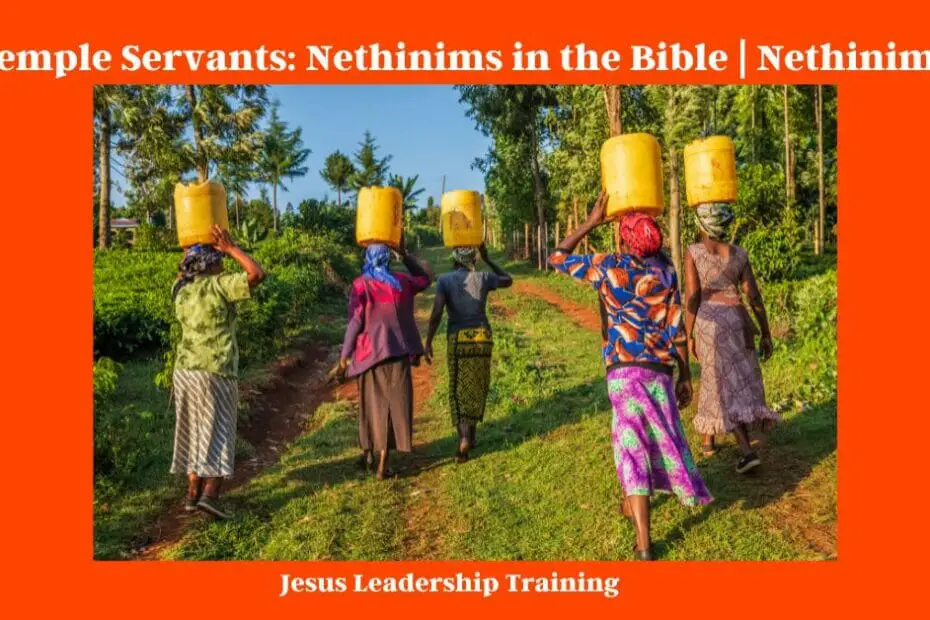
The Nethinim were a group of Temple servants mentioned primarily in the books of Ezra and Nehemiah. Their name is connected with the idea of being given or dedicated for service. They assisted in work connected with the Temple and appear among the groups who returned to Jerusalem after the Babylonian exile.
Although the Nethinim are not among the best-known people in Scripture, their story gives us an interesting glimpse into the organization of worship in ancient Israel and the importance of humble service in God’s work.
The Nethinim were a group of Temple servants mentioned primarily in Ezra and Nehemiah. Their name is associated with people who were “given” or dedicated for service. They assisted the Levites in work connected with the Temple and appear among those who returned to Jerusalem after the Babylonian exile.
Table of Contents
What Does the Word Nethinim Mean?
The word Nethinim comes from a Hebrew term associated with the idea of being given or dedicated.
This likely reflects their role as people assigned or given to assist in sacred service.
The King James Version commonly uses the term Nethinims, while many modern translations use expressions such as Temple servants.
That difference in wording can sometimes confuse Bible readers, but the basic idea is the same.
The Nethinim were a recognized group of servants connected with the work of the Temple.
Where Are the Nethinim Mentioned in the Bible?
The Nethinim appear especially in:
Ezra 2
Ezra 7
Ezra 8
Nehemiah 3
Nehemiah 7
Nehemiah 10
Nehemiah 11
These passages show that they were included among those who returned from exile and participated in restoring the religious life of Jerusalem.
Ezra 8:20 also speaks of Nethinim who had been appointed for the service of the Levites.
That verse gives one of the clearest descriptions of their function.
What Did the Nethinim Do?
The Bible does not give a detailed job description for the Nethinim, but their role appears to have involved practical service connected with the Temple.
They likely assisted with responsibilities that allowed the Levites and priests to focus on their assigned duties.
Temple worship required enormous organization.
There were sacrifices.
Water had to be supplied.
Wood had to be prepared.
Buildings had to be maintained.
Equipment had to be cared for.
People had to organize offerings, transportation, storage, and other practical needs.
The Nethinim seem to have belonged to the group of workers who helped make this system function.
Their service reminds us that worship has always involved people faithfully serving in visible and invisible ways.
Were the Nethinim Levites?
No. The biblical lists normally distinguish the Nethinim from the Levites.
Ezra and Nehemiah frequently list several groups separately:
Priests
Levites
Singers
Gatekeepers
Nethinim
This suggests that the Nethinim had their own recognized place within the Temple community.
They served alongside the Levites but were not themselves part of the tribe of Levi.
Were the Nethinim Israelites?
This is a more difficult question.
The Bible does not clearly explain the ancestry of every Nethinim family.
Some scholars have connected them with non-Israelite peoples who were incorporated into Israel and assigned to service.
Joshua 9 records the story of the Gibeonites, who were assigned to cut wood and carry water for the house of God.
Because of similarities between that role and later Temple service, some have suggested a connection between the Gibeonites and the Nethinim.
However, Scripture never directly says:
“The Nethinim were the Gibeonites.”
So that connection should be treated as a possibility rather than a certainty.
What Scripture does make clear is that by the time of Ezra and Nehemiah, the Nethinim were an established part of the religious community.
What Was the Relationship Between the Nethinim and the Levites?
Ezra 8:20 says that the Nethinim had been given for the service of the Levites.
That tells us something important about how Temple responsibilities were organized.
The priests had specific responsibilities.
The Levites assisted in sacred service.
The Nethinim assisted the Levites.
In other words, the Temple functioned through different levels of responsibility and service.
Not everyone had the same role.
But every role mattered.
This principle appears throughout Scripture.
God’s work often depends on many people faithfully carrying out different responsibilities.
Why Did the Nethinim Return to Jerusalem?
When the Jewish people were allowed to return from Babylonian exile, rebuilding Jerusalem involved much more than reconstructing walls and houses.
The Temple and its worship also had to be restored.
That required priests.
It required Levites.
It required singers.
It required gatekeepers.
And it required Nethinim.
Their willingness to return shows that restoring worship required an entire community.
Some people held prominent positions.
Others performed humble service.
But together they helped rebuild the spiritual life of Jerusalem.
Where Did the Nethinim Live?
Nehemiah 3:31 refers to Nethinim living in an area connected with Jerusalem.
Nehemiah 11 also describes Temple servants living in Jerusalem and surrounding communities.
Their location near the Temple would have made practical sense because their responsibilities were connected with Temple service.
Their daily lives were therefore closely tied to the worship life of the city.
Why Are the Nethinim Important?
At first glance, a list of unfamiliar names in Ezra or Nehemiah may seem unimportant.
But the Nethinim remind us of something powerful.
God’s work has always depended on faithful servants whose names are rarely remembered.
Most people know Ezra.
Most people know Nehemiah.
Very few know the names of the individual Nethinim.
Yet without thousands of faithful workers carrying out ordinary responsibilities, rebuilding Jerusalem and restoring Temple worship would have been far more difficult.
Scripture preserves their names because their service mattered.
What Can Christians Learn From the Nethinim?
One of the clearest lessons from the Nethinim is that no act of faithful service is insignificant to God.
Some believers preach.
Some teach.
Some lead.
Others prepare meals.
Clean buildings.
Care for children.
Set up chairs.
Maintain equipment.
Visit the sick.
Welcome visitors.
Serve quietly behind the scenes.
Human beings often measure importance by visibility.
Scripture frequently measures importance by faithfulness.
The Nethinim remind us that God sees the servants who may never stand on a platform.
Their work still matters.
Frequently Asked Questions About the Nethinim
What does Nethinim mean in the Bible?
The term is associated with people who were given or dedicated for service, especially in connection with the Temple.
Are Nethinim and Levites the same thing?
No. Ezra and Nehemiah distinguish the Nethinim from the Levites. The Nethinim appear to have assisted the Levites in Temple service.
Why does the King James Bible say Nethinims?
“Nethinims” is the traditional English form used in the King James Version. Many modern translations simply call them Temple servants.
Were the Nethinim Gibeonites?
Some scholars have suggested a connection because Joshua 9 describes the Gibeonites serving as woodcutters and water carriers for the house of God. However, the Bible does not explicitly identify the Nethinim as the Gibeonites.
Where are the Nethinim mentioned most often?
They appear primarily in Ezra and Nehemiah, especially in lists describing the people who returned from Babylonian exile.
Final Thought
The Nethinim occupy only a small place in the biblical story, but their example carries a large lesson.
The restoration of Jerusalem did not depend only on famous leaders like Ezra and Nehemiah.
It depended on priests, Levites, singers, gatekeepers, families, builders, servants, and many people whose names are barely remembered today.
The Nethinim remind us that God values faithful service, even when that service happens quietly behind the scenes.
Key Scriptures
Ezra 2:43
“The Nethinim…”
Ezra 8:20
The Nethinim were appointed for the service of the Levites.
Nehemiah 7:46
The Nethinim were included among those who returned to Jerusalem.
Application
Ask yourself:
Am I willing to faithfully serve God even when no one notices?
The Nethinim may not have been famous, but their service helped support the worship of God.
The same is true today.
Some of the most important work in God’s Kingdom is done by people whose names may never be widely known—but whose faithfulness is known by God.
Who Were the Nethinims in the Bible
The Nethinim were people assigned to assist in service connected with the Temple.
They were not priests, and they were not the same as the Levites. Instead, they appear to have served in supporting roles that helped the Levites carry out their responsibilities.
Ezra 2:43 introduces a list of Nethinim who returned from Babylon to Jerusalem. Nehemiah 7 gives a similar record.
Their presence among the returning exiles shows that Temple worship required more than priests alone. Many people served behind the scenes to support the worship life of Israel.
The Nethinim are mentioned in the Hebrew Bible in the Book of Joshua in connection with the congregation’s leaders. In Talmudic tradition, they became associated with the Nethinim. They are mentioned at the return from Exile and particularly enumerated in Ezra 2 and Neh 7. The original form of the name was Nethunim, as in the ketiv of Ezra 8:17 ( Numbers 3:9), and means “gift-bearers”.
The word “Nethinim” comes from a Hebrew root that means “given.” They were given to serve in the temple. We first see them mentioned in Ezra 8:20. These were people who had been exiled to Babylon with Zedekiah, but had gone up with Zerubbabel when he led the first inhabitants back to Jerusalem before the rest of the people.. They had married foreigners and so could not serve as priests. However, they could be assigned to certain duties in the temple.

We see them again mentioned in Nehemiah 7:24-26 and 11:21, where they are working on repairing the walls of Jerusalem. They are also mentioned in I Chronicles 9:2 and Ezekiel 44:15. We know that they were singing and playing instruments in the temple (I Chronicles 25:6).
The Nethinim were evidently set apart for special service to God. They could not minister as priests, but they could perform other functions that were just as important, such as singing and helping to repair the temple.
The Nethinim served an important role in Biblical history, even though we do not know a lot about them. What we do know is that they were assigned to serve in the temple after their captivity and that they performed vital functions such as singing and helping to repair the temple. Their story teaches us that even if we are not called to ministry in a traditional sense, we can still serve God in many other ways.
In The Authorized Version They Seemed to be a Group of Temple servants who lived in part of the city and carried water through the water gate. In Earlier times a contingent of Nethinim followed the law of God and served the people of the lands.
The y participated in the second return to the cities of Judah.
The Septuagint Translators included them in the general body of Levites on the first return.
Origins of the term “Nethinim”
The term “Nethinim” first appears in the Hebrew Bible in the book of Ezra (Ezra 2:43-54; 7:7). The word itself is derived from the Hebrew verb “natan,” which means “to give.” The Nethinim were thus a group of people who had been given over to the service of the tabernacle or temple.
In biblical times, the Nethinim served a variety of roles within the temple complex. They were responsible for caring for the temple grounds, drawing water for the priests, and performing other menial tasks. The Nethinim were also sometimes pressed into military service, and they even participated in the construction of Solomon’s temple (1 Chronicles 9:2).
Despite their relatively low status within society, the Nethinim played an important role in the functioning of the ancient Israelite religion. Without their dedication to service, the temple would not have been able to function properly.
The term “Nethinim” is derived from a Hebrew word meaning “to give.” The Nethinim were a group of people who had been given over to the service of the tabernacle or temple in ancient Israel. They played an important role in keeping the temple complex running smoothly by performing tasks such as caring for the grounds and drawing water for the priests. Despite their low status within society, the Nethinim were essential to the functioning of the ancient Israelite religion
The role of the Nethinim in ancient Israel
The precise origins of the Nethinim are unclear. Some scholars believe that they were slaves who were captured in war and assigned to work in the temple, while others believe that they were simply poor people who were willing to work for the temple. Regardless of their origins, the Nethinim played an important role in the day-to-day operations of the temple and the city of Jerusalem.
The Nethinim performed a variety of tasks, including cleaning the temple, preparing sacrifices, carrying wood and water for the priests, and serving as guards. They also had their own quarters in the city of Jerusalem, where they lived with their families. In addition to their duties at the temple, the Nethinim also helped to keep the city clean and orderly. They served as garbage collectors, street cleaners, and sewage disposal workers. Without the Nethinim, it is unlikely that Jerusalem would have been able to function as smoothly as it did.
The Nethinim played a vital but often unheralded role in ancient Israel. They performed a variety of tasks, both at the temple and in the city of Jerusalem, that helped to keep things running smoothly. Without them, it is unlikely that Jerusalem would have been able to function as effectively as it did. For this reason, we should remember the Nethinim today and be grateful for all those who perform essential but often thankless tasks.
Description of the Nethinim
The Nethinim are first mentioned in the book of Ezra. They are mentioned again in the book of Nehemiah. In the book of Nehemiah, they are called the Gibeonites. The Nethinim were a group of temple servants who served in the tabernacle and later in the temple. They were also known as the Gibeonites. They were among the group of people who returned from exile with Ezra and Nehemiah.
The Nethinim were probably recruited from among the prisoners of war that were taken captive during one of Israel’s military campaigns. They may have also been slaves that were purchased or given as gifts to the tabernacle or temple. The Nethinim performed various duties such as caring for the furnishings of the tabernacle or temple, preparing sacrifices, and carrying out other tasks that were assigned to them by the priests.
Over time, the term “Nethinim” came to be used more broadly to refer to any class of temple servants or workers. It is possible that some of the Nethinim later became Levites, although this is not certain.
The last mention of the Nethinim is in Neh 7:60-73 where they are listed among those who participated in dedication ceremony for the rebuilt walls of Jerusalem led by Ezra and Nehemiah.
The Nethinim were a group of temple servants who served in both the tabernacle and later in Solomon’s temple. They most likely came from among prisoners of war that were taken captive during Israel’s military campaigns but they may have also been slaves that were purchased or given as gifts to either religious structure. Over time, their title broadened to describe any sort of lowly worker within these same buildings regardless if their origins stemmed from warfare or not. The last mention Scripture makes concerning these individuals is during Nehemiah’s leadership when they’re recorded as participating in Jerusalem’s wall rebuilding project post-exile alongside Ezra. Consequently, we learn that they returned to Jerusalem from captivity shortly after 538 BCE..
What is known about the Nethinim ancestry?
The exact origins of the Nethinim are unknown, and there is much debate amongst biblical scholars as to who they were. Some believe that they were descended from the Gibeonites, a group of Canaanites who tricked Joshua into making a treaty with them (see Joshua 9:3-27). Others believe that they were simply slaves freed from captivity, either by the Israelites or by the Babylonians. Still others believe that they were a mix of both groups.
What impact did they have on Jewish history?
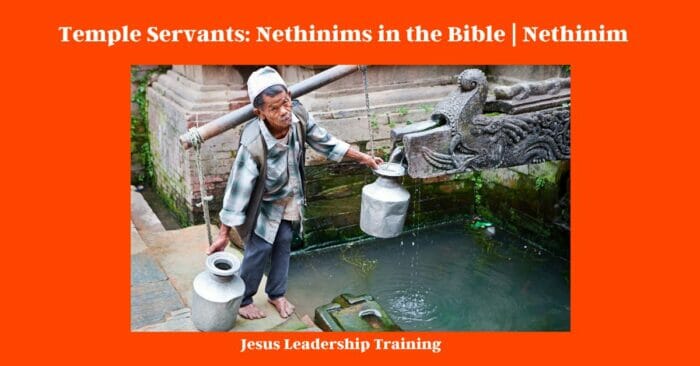
When the Israelites entered the Promised Land, they came into contact with a people known as the Gibeonites. The Gibeonites tricked Joshua into making a covenant with them, and as a result, they were made slaves (Joshua 9:23). The Nethinims are first mentioned in connection with the Gibeonites in Joshua 9:27, where they are said to have been given to the Levites as slaves.
From that time on, we see that the Nethinims continued to serve in both the tabernacle and temple. In 1 Chronicles 9:2 we learn that they had responsibility for bringing wood to be used in sacrifices, and in Ezra 2:43-54 they are listed among those who returned from exile with Zerubbabel. In Nehemiah 7:46-60 we see that they continued to live in their own separate towns and remained distinct from other Israelites.
Are the Nethinim Mentioned in the Apocrypha
I could not locate the mention of them but they were present until the time of Jesus Christ in the New Testament, so were active during the time period that the Apocrypha was written and accumulated.
Nethinim are Mentioned 18 times in the King James Bible
- 1 Chor 9:2
- Ezra 2: 43,58,70,
- Ezra 7:7, 24
- Ezra 8: 17,20
- Neh 3.26
- Neh 3: 31
- Neh 7: 46,60,73
- Neh 10:28
- Neh 11: 3,21
Best Bible Encyclopedias and Dictionaries
Below is a table featuring some highly regarded Bible Encyclopedias and Dictionaries along with their publishers and websites where they can be found or purchased.
| Title | Publisher | Website |
|---|---|---|
| The International Standard Bible Encyclopedia | Eerdmans | Eerdmans |
| Zondervan’s Pictorial Bible Dictionary | Zondervan | Zondervan |
| Easton’s Bible Dictionary | Thomas Nelson | Thomas Nelson |
| Holman Illustrated Bible Dictionary | B&H Publishing Group | B&H Publishing Group |
| The New Unger’s Bible Dictionary | Moody Publishers | Moody Publishers |
| HarperCollins Bible Dictionary | HarperOne | HarperOne |
| Vine’s Complete Expository Dictionary of Old and New Testament Words | Thomas Nelson | Thomas Nelson |
You can generally find these resources on the publishers’ websites, as well as other online book retailers such as Amazon or Christianbook. It’s always good practice to confirm availability and review additional details on the specific websites or other reliable online bookstores.
Final Thoughts – Who are the Nethinims in the Bible
They were servants of the Levites their duties included:
- Drawers of Water
- Hewers of wood
- Servants of Solomon
They Were Called :
- children of Ziha
- children of Solomon
- children of Hasupha
- children of Tabbaoth
- Hereditary temple servants
They were Ministers of this house of God, and served in a state of servitude, serving at the altar of the Lord.
God Bless Greg